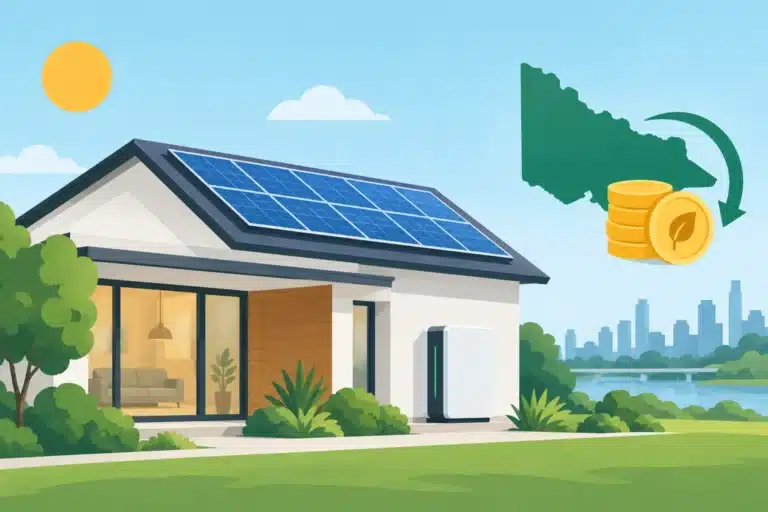
A battery can change what your solar system does after 5 p.m. Instead of sending excess daytime generation to the grid for a modest feed-in credit, you can store it and use it when household demand and electricity rates are often higher. That is why the solar battery rebate Victoria homeowners search for matters – but the answer is not always a simple state-funded cash payment.
Victorian battery incentives have changed over time. The strongest support available to many households is now commonly a federal upfront battery discount, while Victoria’s Solar Homes offerings and other state programs can have separate rules, funding limits, and application windows. The practical approach is to confirm every incentive available for your address before choosing a system or signing a contract.
Solar Battery Rebate Victoria: The Current Picture
Victorian homeowners should be careful with advertisements that treat every incentive as one permanent rebate. Programs can close, reopen, change eligibility criteria, or be replaced by a different form of support. A rebate promoted a few years ago may no longer accept new applications, even though a federal battery incentive can still reduce the installed price today.
For many eligible solar battery installations, the key saving is the federal battery discount available through Australia’s Small-scale Renewable Energy Scheme. It is applied through certificates created for eligible systems, and it normally appears as an upfront reduction in the quoted price rather than money paid into your bank account after installation.
The value depends on the battery’s eligible capacity, installation date, location, equipment approval, and the current certificate value. It also reduces over time under the program’s schedule. This is why two homes can receive different discounts for similar batteries, and why a quote should show the incentive as a separate line item.
Victoria may also offer solar panel rebates or loans for qualifying owner-occupiers. These are not automatically battery rebates. If you are considering solar panels and storage together, ask whether each product is eligible under its own program and whether the incentives can be combined. Do not assume that a solar rebate will pay for the battery portion of a package.
What Makes a Battery System Eligible?
Eligibility is about more than owning a home in Melbourne or regional Victoria. The exact rules can vary, but installers generally need to confirm that the battery model, capacity, installation method, and solar connection meet the relevant program requirements.
A battery usually needs to be installed with a new or existing eligible solar system. The equipment must meet applicable product standards, and the installation must be completed by appropriately accredited professionals. Capacity limits can apply, particularly where the federal discount is concerned. Larger batteries may still be a good fit for a high-use household, but not every kilowatt-hour may attract the same level of support.
Your property also needs to be technically suitable. A switchboard upgrade, limited wall space, shading issues, restricted access, or an older inverter can affect the final scope and cost. A low advertised battery price is not useful if it excludes essential electrical work required to install it safely.
Before you proceed, request written confirmation of the following:
- the battery model and usable storage capacity
- the estimated federal incentive and any Victorian incentive included
- whether the quote includes installation, electrical upgrades, approvals, and commissioning
- the battery, inverter, and workmanship warranty terms
- whether the system includes backup power, and what circuits it will support
That level of detail makes comparisons fair. It also protects you from confusing a pre-incentive price with the final installed price.
A Rebate Helps, but the Right Size Creates Savings
The best battery is not necessarily the biggest one. It is the one that matches your household’s solar production, evening consumption, budget, and future plans.
A family that uses most of its electricity after work may benefit from a battery that stores surplus solar for cooking, heating, cooling, laundry, and overnight base loads. A household that is empty during the day but has a large solar system can also be a strong candidate. On the other hand, if your panels rarely produce surplus energy, adding more panels or improving daytime energy use may deliver better value before installing storage.
Consider the loads you expect to add over the next few years. An electric heat pump hot-water system, induction cooking, electric vehicle charging, and reverse-cycle air conditioning can all change your energy profile. In some homes, it makes sense to install a battery that can expand later. In others, a larger battery from the start offers better value once installation costs are considered.
The difference between nominal capacity and usable capacity matters too. A battery may be marketed with a large total capacity, but not all of that energy is available for everyday use. Ask how much usable storage you can expect, what power output the battery can deliver, and whether that output is enough to run the appliances you care about at the same time.
Backup Power Is a Separate Decision
Many Victorian homeowners expect a solar battery to keep the house running during a blackout. That is possible with some systems, but it is not automatic.
Standard solar systems shut down during an outage to protect network workers. To provide backup, the battery system needs the right hardware, configuration, and electrical design. Some setups support only selected essential circuits, such as lights, refrigeration, internet, and a few power outlets. Others can support more of the home, subject to the battery’s output and the loads being used.
Whole-home backup costs more and is not always necessary. If your priority is reducing bills, an essential-load backup design may be the sensible balance. If you work from home, rely on medical equipment, live in an outage-prone area, or want greater energy independence, the added investment may be worthwhile. The important point is to make the decision before installation, not after.
Compare Quotes on Total Value, Not a Headline Discount
A genuine solar battery saving should be easy to understand. The quote should show the equipment, incentives, labor, warranty support, and any extra electrical work clearly. If one price is significantly lower than the others, find out what has been left out.
Panel and battery brands matter, but installation quality matters just as much. Storage systems manage high-voltage equipment and need careful design, compliant placement, clean wiring, correct commissioning, and ongoing support if an issue arises. Work with a provider that can explain the design in plain language and coordinates installation with qualified, independent professionals.
At Sol Excel, the focus is on practical system design, dependable products, qualified installation, and pricing that stands up to comparison. A site-specific assessment is the best way to identify the incentives that apply and avoid paying for capacity or features your household will not use.
Questions to Ask Before You Claim Any Incentive
First, ask whether the quoted incentive is confirmed or estimated. Certificate values and program rules can affect the final figure, so your provider should explain the assumptions used.
Next, ask whether the battery is approved for the incentive and whether its capacity is fully eligible. This matters particularly for larger systems and for homes planning to add more storage later.
Finally, ask what happens if an application is declined or a program changes before installation. A professional quote should make clear who carries that risk and what your final price could be. Never rely on a verbal promise when incentives form a meaningful part of your purchase decision.
A solar battery should earn its place in your home through lower grid purchases, better use of your own solar energy, and the level of backup you actually need. Check the available rebate support, but choose the system around your household – that is where the long-term value is found.