A solar quote can look straightforward until you reach the inverter line. The microinverters vs string inverters decision affects more than the upfront price. It can change how your system handles shade, how easily you can track panel performance, and what it costs to expand later.
For most homeowners, the right answer is not simply the most expensive option or the one a neighbor chose. It depends on your roof layout, daily shading, energy goals, and budget. A well-designed solar system should lower your power bills for years, not just look good on installation day.
Microinverters vs String Inverters: The Main Difference
Every solar panel produces direct current electricity. Your home uses alternating current electricity, so an inverter is required to convert that power into usable energy.
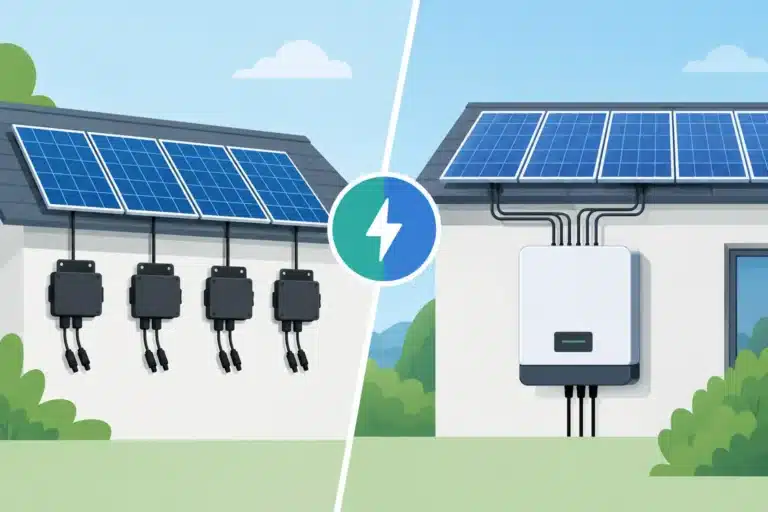
A string inverter is one central unit, usually installed near your switchboard, garage, or meter. Panels are connected together in groups called strings, and their power is converted at that single inverter.
Microinverters are smaller units installed beneath individual solar panels. Each panel has its own inverter, meaning every panel converts electricity independently before sending it through the system.
That basic design difference drives the trade-offs. String inverters are generally simpler and less expensive. Microinverters generally offer greater flexibility where roof conditions are complicated.
When a String Inverter Is the Better Value
For a simple, unshaded roof, a quality string inverter is often the most cost-effective choice. If the panels face the same direction, sit at a similar pitch, and receive consistent sunlight, a string system can produce excellent results without the higher equipment cost of microinverters.
This is why string inverters remain common in residential solar installations. They are proven, efficient, and easier to access if service is required. Rather than working on equipment beneath a panel, a technician can inspect the central inverter at ground level or in the garage.
The lower upfront cost can also allow a homeowner to install more solar capacity within the same budget. In some cases, adding an extra panel or two with a string inverter may deliver more total generation than choosing microinverters with a smaller array.
String inverters are particularly practical when:
- Your roof has one large, clear area with consistent sun exposure.
- Panels will face the same direction and use the same tilt angle.
- You want the strongest upfront value from a standard-size solar system.
- You are planning a straightforward system with no major roof obstacles.
A string inverter does have one limitation: panels in the same string are linked. If one panel is heavily shaded, dirty, damaged, or producing less power, it can reduce the output of other panels in that string. Modern system design can reduce this issue by separating roof faces into different strings or using power optimizers where needed, but the layout still matters.
Why Homeowners Choose Microinverters
Microinverters are designed for roofs where panels will not all perform the same way. Think of a roof with morning shade from a tree, afternoon shade from a chimney, panels spread across several roof faces, or different panel tilt angles.
Because each panel works independently, a shaded or underperforming panel does not hold back the whole string in the same way. The unaffected panels continue operating at their available output. This can improve overall production where partial shade is a regular reality.
Panel-level monitoring is another major advantage. With microinverters, homeowners can often see the output from each individual panel through a monitoring app. If one panel is not performing as expected, the problem can be identified more precisely.
Microinverters also make future expansion easier in many situations. If your household later adds an electric vehicle, heat pump, electric water heater, or home battery, you may want more solar capacity. Adding panels to a microinverter system can be more flexible because each new panel has its own inverter. That said, roof space, electrical limits, permits, and local utility rules still need to be checked before expanding any system.
The trade-off is price. Microinverter equipment and installation usually cost more than a comparable string inverter setup. There are also more electronic components on the roof, which can make a future service visit more involved if a unit needs replacement.
Shade Is Important, but It Is Not the Only Factor
Shade is often presented as the deciding factor in microinverters vs string inverters, but it should be assessed honestly. A small shadow that crosses one panel for a few minutes may not justify a significant upgrade in inverter cost. Regular shade from nearby trees, roof vents, chimneys, or neighboring buildings is a different matter.
A proper site assessment should look at when the shade occurs, which panels it affects, and how much annual production it is likely to reduce. Morning shade may have less impact than shade during the middle of the day, when solar generation is strongest. Seasonal changes matter too. A tree that seems harmless in summer can cast a longer shadow during winter.
Roof direction also deserves attention. A south-facing roof in the Northern Hemisphere generally receives the most annual sun, but east- and west-facing panels can still be valuable. They spread generation across the day, which may better match household usage. Microinverters can suit multi-directional roofs well, although a properly designed multi-string inverter can also handle different roof faces.
Monitoring, Reliability, and Warranties
Both inverter types can provide useful monitoring. A string inverter commonly shows total system production. Microinverters typically provide panel-by-panel data. Detailed monitoring is helpful, but it should not be the only reason to spend more. Many homeowners check their app regularly in the first few months and then only occasionally.
Reliability should be considered in terms of product quality, warranty coverage, and installer support, not just inverter type. A central string inverter is easier to reach if it needs replacement. Microinverters are usually backed by long product warranties, but servicing one may require access to the roof and temporary removal of a panel.
Ask your installer exactly what is covered: the inverter product warranty, panel warranty, workmanship warranty, monitoring access, and labor required for a warranty claim. Clear answers matter more than broad promises.
It is also worth asking whether the proposed inverter is compatible with your future battery plans. Some string inverter systems are built as hybrid inverters and are designed to work with batteries. Microinverter systems can also pair with battery storage, but the design and equipment costs may differ. Battery compatibility should be part of the conversation before installation, especially if energy backup is a priority.
How to Compare Quotes Fairly
Do not compare solar quotes by system size alone. Two 8 kW systems can have very different expected output, component quality, warranty terms, and installation standards.
Look at the panel brand and model, inverter brand, number of panels, panel orientation, estimated annual production, workmanship warranty, and any assumptions about shade. Confirm whether the quote includes electrical upgrades, monitoring setup, permits, and applicable incentives. A lower advertised price can become less attractive if essential work is treated as an extra.
For homeowners weighing microinverters, ask for an estimated production comparison against a string inverter design for the same roof. If the expected generation difference is small, the lower-cost string option may be the better financial decision. If shade and roof complexity create a meaningful performance gap, microinverters may earn their higher price over time.
Sol Excel focuses on matching the equipment to the property and the household’s energy use, with qualified installers and clear pricing. The aim is not to sell complexity for its own sake. It is to install a system that makes financial sense and performs reliably.
Choose for Your Roof, Not a Sales Pitch
A string inverter is often the smart choice for a clear, uniform roof and a budget-focused solar installation. Microinverters are often worth considering for shaded, multi-directional, or expansion-ready roofs where independent panel performance has real value.
Before signing a quote, ask for a roof-specific design and a plain-language explanation of why that inverter setup suits your home. The right system is the one that turns your available roof space into dependable savings without paying for features you do not need.