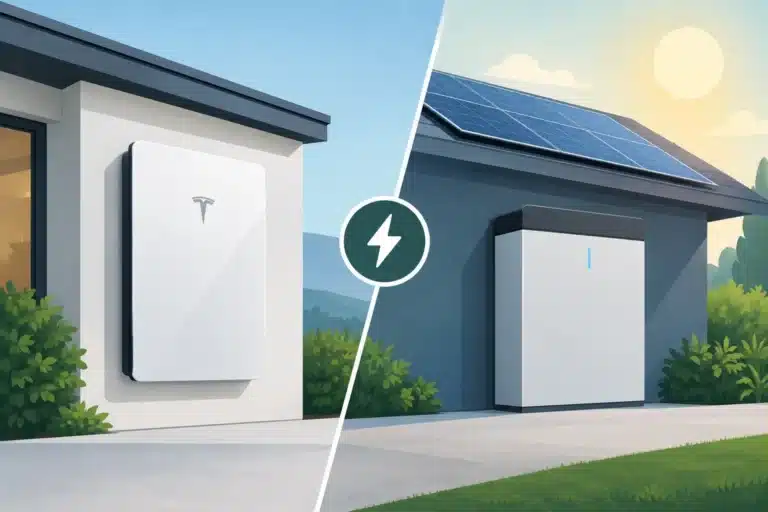
A battery can turn a solar system from a daytime bill reducer into a home-energy asset that works after sunset. But a Tesla Powerwall vs solar battery comparison is not simply a choice between a famous name and an alternative. Power capacity, backup requirements, existing equipment, installed cost, and local incentive eligibility can all change which option delivers the better return for your home.
The right battery should match the way your household uses electricity. A family that runs air conditioning through hot evenings has different needs from a homeowner who mainly wants outage protection or a way to avoid expensive peak-rate power. Start with your goals, then compare products on the details that affect everyday performance.
Tesla Powerwall vs solar battery: the key difference
Tesla Powerwall is itself a solar battery. The practical comparison is between Tesla’s Powerwall system and other home battery brands that may offer different capacities, configurations, warranties, or price points.
Tesla has built strong recognition because Powerwall combines battery storage, intelligent energy monitoring, and a polished app experience. Depending on the model and system design, it can store solar power for use at night, provide backup power during an outage, and help manage household energy use. For homeowners who value a well-known platform and simple controls, that is a compelling package.
Other battery options can be just as suitable, and sometimes better suited, for a particular project. Some pair easily with an existing solar inverter. Others allow more flexibility in battery size, offer modular expansion, or provide a lower installed cost for households with modest electricity demand. A good comparison looks past the logo and asks what the completed system will do at your property.
Start with your household energy goals
Before comparing specifications, decide what you expect the battery to accomplish. Most homeowners are trying to achieve one or more of three outcomes: use more of their own solar energy, reduce purchases from the grid during expensive periods, or keep essential appliances running when the grid goes down.
A battery designed mainly for solar self-consumption does not necessarily need to back up every circuit in the home. If your priority is bill savings, a right-sized unit that stores excess daytime generation for the evening may make more financial sense than a larger whole-home backup system.
Backup changes the conversation. Running lights, refrigeration, internet, and selected power outlets during an outage requires less battery capacity than supporting central air conditioning, electric cooking, a pool pump, and multiple large appliances. Whole-home backup can be valuable, but it needs careful load assessment. Your installer should identify the appliances you want to support and explain how long the selected battery is likely to last under realistic use.
Capacity is only half the story
Battery capacity is usually stated in kilowatt-hours, or kWh. This tells you how much energy the battery can store. It is an important number, but not the only one that matters.
Power output, measured in kilowatts, determines how much electricity the battery can supply at one time. A battery may have enough stored energy to last through the evening yet struggle if several high-demand appliances start at once. Air conditioners, electric heaters, ovens, dryers, pumps, and EV chargers can create substantial demand spikes.
Tesla Powerwall is often considered by households seeking a higher-capacity battery with strong backup capability. However, the best size depends on your solar production, overnight usage, and daytime demand. Installing more storage than your solar panels can regularly recharge may leave capacity underused. Installing too little can mean the battery empties early in the evening, leaving you back on grid power when rates are highest.
Review at least 12 months of electricity bills where possible. Seasonal patterns matter. A home that uses far more power in summer for cooling or winter for heating should be designed around those peaks, not an annual average that hides them.
Compatibility can affect the final price
The battery is not a standalone purchase. It has to work with your solar panels, inverter, switchboard, monitoring equipment, and backup setup.
For a new solar installation, you have more freedom to choose a package designed to work together from day one. Tesla Powerwall can be an attractive option in this situation, particularly when homeowners want an integrated ecosystem and future energy management features. Other brands may be a better fit when a specific inverter, panel layout, or budget target shapes the design.
For an existing solar system, compatibility is especially important. Some batteries are AC-coupled, meaning they can be added alongside many existing solar systems. Others are designed for DC coupling or work best with particular hybrid inverters. Neither approach is automatically better. The right option depends on the equipment already installed and whether you plan to replace or retain your inverter.
Do not compare battery sticker prices without comparing the full installed scope. A lower-cost battery can become less competitive if it requires major switchboard work, inverter replacement, or extra backup hardware. Likewise, a premium system may deliver better value when it includes the controls and installation components needed for the backup outcome you want.
What to compare beyond the purchase price
A battery should be assessed as a long-term energy investment, not just an appliance. Ask for a clear proposal that shows usable storage capacity, continuous power output, backup configuration, equipment included, workmanship, and warranty terms.
Pay close attention to the difference between a product warranty and an installation warranty. The product warranty covers the battery under stated conditions. The installation warranty covers the workmanship and electrical components fitted as part of the project. Both matter.
Also ask how the battery warranty is measured. Many manufacturers specify a period of years along with an energy-throughput limit or guaranteed retained capacity. A longer headline warranty is useful, but the fine print should still suit how you expect to use the system.
Monitoring deserves consideration too. Tesla’s app is a major selling point for many owners because it makes solar generation, home consumption, battery charge, and grid imports easy to see. Competing systems also offer monitoring, although features and interfaces vary. The most useful app is one that helps you understand when your home uses power and confirms the battery is performing as expected.
Is Powerwall worth the premium?
For some homeowners, yes. Tesla Powerwall may be worth paying more for if you prioritize brand confidence, a refined monitoring experience, significant backup capability, and an integrated approach to home energy. It can be particularly appealing when the battery is part of a larger plan that includes solar, electric heating and cooling, or future EV charging.
For others, the best value may come from another battery with comparable usable capacity at a lower installed price. This can be true when backup needs are limited, when the home already has compatible equipment, or when the household’s evening power use is relatively low.
There is no honest one-size-fits-all answer. The battery that looks cheapest can cost more over time if it is undersized, poorly matched to the solar system, or unable to run the circuits that matter in an outage. The most expensive option is not automatically the best either if its capacity and backup features will rarely be used.
Get a design based on real usage
A proper battery recommendation starts with your roof, solar output, electricity bills, switchboard, and household priorities. It should also account for available incentives and explain them clearly rather than treating rebates as guaranteed savings.
Work with qualified installers who can explain the design in plain language, confirm the equipment is approved for your area, and provide clear warranty documentation. Price matters, and it should. But a low price only creates real value when the equipment is correctly sized, professionally installed, and supported after the job is complete.
The best next step is simple: decide which appliances you want powered after dark and during an outage, then request a like-for-like comparison. A battery choice becomes much clearer when every quote is measured against the same household outcome, not just the biggest number on a brochure.